AI Fluency for Everyone
The ability to work effectively, efficiently, ethically, and safely within emerging modalities of Human-AI interaction.
It's becoming very overwhelming to read about the AI hype. On one side, you can see that many of the AI tools can make you productive. On the other, AI tools load your brain with so much information it makes you unproductive. A useful skill to learn is to become AI fluent, to help you navigate this phase.
Rick Dakan and Joseph Feller define AI fluency as:
The ability to work effectively, efficiently, ethically, and safely within emerging modalities of Human-AI interaction.
In practice that means knowing what to hand over, how to explain what you want, how to judge what comes back, and where your responsibility begins and ends. It's a skill, so it can be practiced. It's also a general skill, so you don't need to have technical knowledge to learn.
Why "fluency" is the right word
Being fluent in a language doesn't mean knowing every word. It means you can hold a conversation, notice when you've been misunderstood, and continue the conversation. Working with AI tools is the same.
Prompts are useful, until they're not. A prompt can help you get an outcome in one-attempt, or several, but it's easy to miss why each prompt works. Competencies are more sticky, and they can carry over as the tools evolve.
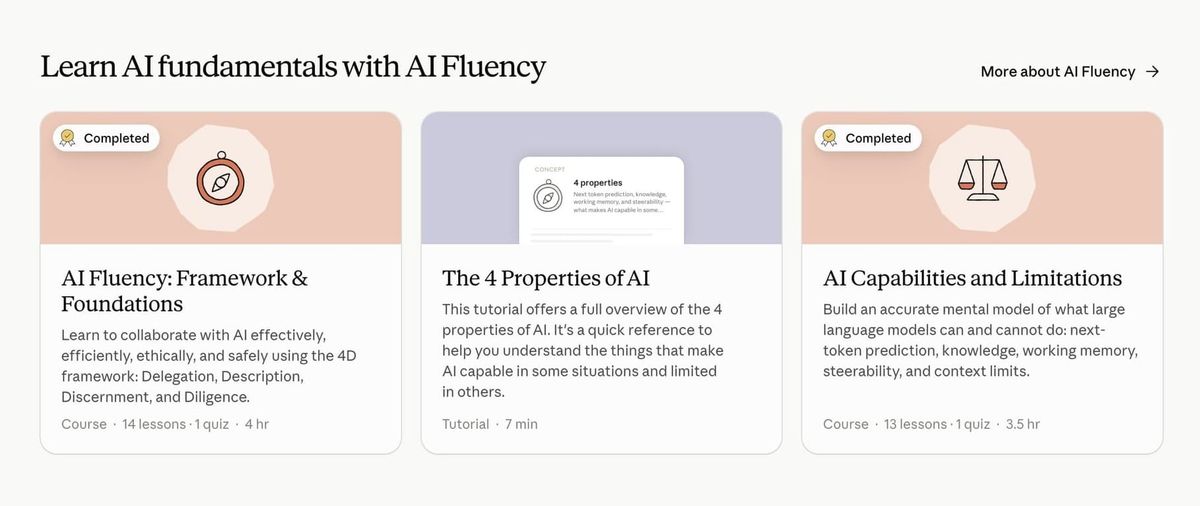
The simplest map of those competencies is the 4D Framework for AI Fluency. The framework emerged from the research collaboration of Rick Dakan of Ringling College of Art and Design and Joseph Feller of Cork University Business School, University College Cork.
The 4Ds are:
- Delegation
- Description
- Discernment
- Diligence
Delegation: deciding what work needs doing and who should do it: you, the AI, or both together. Before a single prompt gets written, you have to judge whether the task belongs with an AI at all, and that judgment is yours alone.
Description: communicating the task clearly. What you want produced, how you want it approached, and how you want the AI to behave along the way. A prompt is Description in practice.
Discernment: judging the quality of the output. AI output arrives fluent and confident whether it's right or wrong. Confidence though, is not evidence. Discernment is the habit of checking the product the AI produces, questioning the reasoning, and noticing what's missing.
Diligence: taking responsibility. If you send it, publish it, or act on it, it's yours. That means choosing tools thoughtfully, being honest about how the work was made, and verifying before you deploy.
The four are interconnected. An unclear description develops into a discernment problem. Results you never carefully delegated are results you can't diligently own.
Why "for everyone"
The people with the most to gain are the ones whose work is made of language, judgment, and coordination, which is to say most working people. Teachers, managers, freelancers, founders, administrators, students. Knowledge workers.
None of the four competencies requires a coding practice.
Delegation is a management.
Description is a communication.
Discernment is critical reading.
Diligence is professional ethics.
You've been practicing all 4 your whole working life, just not with Claude or ChatGPT.
Which is why fluency develops the way practical skills develop: deliberate repetition over a long period of time.
AI has limitations
AI will not always make you faster and more productive. Some tasks take longer with AI than without it, and the fluent approach is noticing that early and doing the work yourself. You'll save time and tokens.
Also, AI tools are not always reliable. In the early days, ChatGPT had a moment. Then it was Claude. Now, a new term is emerging "claudish". Which means English by Claude. A way to describe how Claude is writing its outputs, which in real life, nobody speaks like that. The models continue to change and results do the same. Handing everything over to the AI agent will cost you in the long run if a model no longer writes "english".
The goal with Karaza
Karaza is an AI-fluency and training practice for founders, freelancers, and entrepreneurs, based in the UAE. A growing set of written tutorials show you how to setup tasks with Claude, Cowork, and Skills.
Start today
If you take one thing from this post, take the practice. Pick one task from your week. A document to draft, a decision to think through, a pile of notes to organize.
Think through the four questions in hand.
What am I delegating?
Have I described it clearly?
Is this output useful?
What am I responsible for before I use it?
That's the first step to AI fluency.